

Real-Time Healthcare Logistics Platform
Designed an end-to-end healthcare logistics platform connecting rugged scanners, tablets, dashboards, and operational workflows to improve real-time specimen visibility and validation.


Overview
Healthcare teams relied on fragmented manual workflows to coordinate specimen movement between locations, creating operational blind spots, delayed validations, and increased risk during time-sensitive handoff processes.
The goal was to design a real-time operational platform that improved workflow visibility, reduced manual coordination, and streamlined specimen tracking across multiple operational roles and devices.
My Role
I led the end-to-end UX design across the specimen journey, from discovery and workflow strategy through interaction design, prototyping, validation, and implementation.
Discovery & Research
Interviewed hospital staff across roles to understand workflows, handoffs, and pain points.
Strategy & Design
Mapped end-to-end journeys and translated insights into connected workflows across devices.
Prototyping & Validation
Created wireframes and prototypes, validated workflows, and iterated based on feedback.
Collaboration & Delivery
Partnered with Product and Engineering through implementation, launch, and iteration.
What was the Problem?
Clinical specimens were tracked through fragmented manual workflows, disconnected systems, and paper-based handoff processes. Once specimens left the clinic, teams lacked real-time visibility into their location, status, and chain of custody.
Delayed diagnoses
Specimen tracking failures
High coordination overhead across operational teams

Discovery and Key Insights
Conducted interviews with hospital staff across different roles to understand their day-to-day workflows, movement across locations, handoffs, and key pain points.
Handoffs created risk
Ownership became unclear as specimens moved between teams and locations.
Speed needed safeguards
Time-sensitive workflows needed to stay fast without allowing critical steps to be skipped.
The goal was to design a real-time operational platform that improved workflow visibility, reduced manual coordination, and streamlined specimen tracking across multiple operational roles and devices.
Visibility was fragmented
Teams lacked a shared view of specimen status, location, and ownership.
Different roles needed different information
Each operational role needed the right information and actions at different stages of the specimen journey.
System Complexity
Multiple operational stakeholders with competing priorities
Zero tolerance for errors or ambiguity
Time-critical workflows under pressure
Need for real-time visibility across locations
End-to-End Workflow Ecosystem (System Thinking)

Rather than designing isolated interfaces, I focused on the complete operational journey as a connected ecosystem spanning clinic intake, transport validation, lab processing, and real-time monitoring.
A simplified view of the primary sample journey across clinic, transport, and lab.
Translating Strategy Into Critical Workflows
Core User Journey
A. Clinical Sample Association
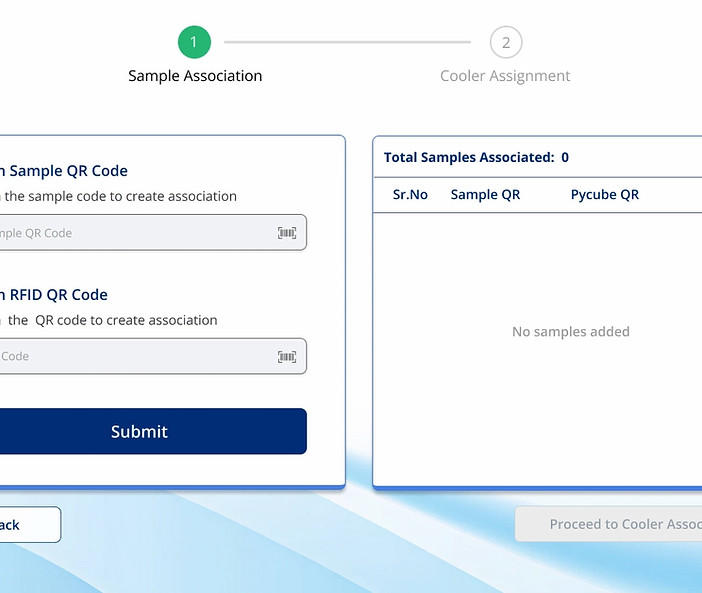
Pathologists associate each physical sample with an RFID tag before handoff, ensuring traceability from the very first step of the journey.
Final Solution

01. Entry Point
Clinic staff select Initiate Sample Scan to begin the specimen workflow.

02. Identity Verification
A quick PIN verifies the pathologist before critical specimen actions.

03. Sample Association
Staff scan the sample and RFID codes to create a traceable association.

04. Association Saved
Clear confirmation verifies the sample was successfully linked before proceeding.

05. Cooler Assignment
Associated samples are assigned to a cooler for the next handoff.

06. Confirmation
Staff confirm the assignment, then add another cooler or exit the workflow.
Why the flow is linear
Why confirmation matters in healthcare
The sample association flow was intentionally designed to be linear. In a time-critical clinical environment, reducing branching decisions helps clinicians move quickly while minimizing the risk of missed or incorrect steps during sample handoff.
Clear confirmation states ensure that each sample is successfully linked to its RFID tag before proceeding. In healthcare workflows, ambiguity at this stage can lead to lost samples, delayed diagnoses, and compliance risks later in the process.
Design Iteration : Balancing Speed with Accountability
BEFORE

Traditional Login
Full Login authentication created friction for staff moving through time-sensitive workflows.
Initial Authentication
Reduce friction without losing accountability

AFTER

Lightweight Identity Verification
Replaced full login with PIN verification to reduce friction while maintaining individual accountability.
Iterated Authentication
CARRYING ACCOUNTABILITY INTO THE WORKFLOW
BEFORE
Action was captured but it was difficult to say who performed this critical step

The PIN wasn't just a faster authentication method. It allowed individual identity to carry into critical specimen actions, improving traceability without slowing down the workflow.
Ownership Not Visible
Who is reponsible for this cooler association?
AFTER

Verified identity (E.g Pathologist: John) is tied to the specimen action ensuring clear accountability
Ownership Clear and Attributed
B. Courier Pickup
Once samples are secured in coolers, couriers use the pickup dashboard to identify and collect coolers ready for transport
from the collection area

01. Ready for Pickup
Couriers review available coolers and their sample counts before initiating pickup.
02.Identity Verification
A quick PIN verifies the courier before responsibility for the cooler is transferred.

03.Pickup Confirmed
Pickup confirmation records who collected the cooler and when.
Supporting Traceability After Pickup
Pickup History
Pickup history gave staff a quick way to verify whether a cooler had already been collected, who picked it up, and when — especially when another staff member needed to confirm its status
Tradeoff: Speed vs. Validation
Stakeholders wanted to minimize additional steps. I advocated for explicit validation at critical handoffs, integrating it naturally into the flow to maintain efficiency while reducing ambiguity and downstream risk.

Why this step matters operationally
By validating pickup at the point of exit, the system reduces downstream errors that are difficult to detect once samples are in transit.
Extending Traceability Beyond Pickup
RFID-enabled checkpoints captured when coolers and samples crossed critical entry and exit points, extending visibility across the physical journey.
01. Collection Area
02. Clinic Exit Checkpoint
03. Lab Entry Checkpoint
04. Lab Recieving


In transit

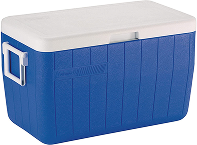
Courier picks up the cooler with samples
Cooler and samples are validated before exit.
Cooler and samples are validated on arrival.
Samples are handed off for processing.
How it works

Ceiling RFID readers + SmartTrack Cube scan the cooler and sample tags automatically.

The tablet compares detected samples against expected contents and shows the result in real time.

Each checkpoint stores the time, location, cooler, samples, validation result, and verified user.
Handling Exceptions at Critical Checkpoint
When checkpoint validation failed, the interface helped users understand the issue, retry the scan, or resolve known exceptions without losing traceability.

01. Validation Matched
Cooler, sample count, and courier identity match the expected handoff.

02. Mismatch Detected
The system flags missing or unexpected samples before the cooler can move forward.

03. Controlled Confirmed
Authorized users can override known scan exceptions while preserving traceability.
C. Monitoring & Visibility
Once specimens entered transit, the platform provided real-time visibility across locations, helping teams monitor workflow states, identify delays, and intervene early.
Dashboard Experience
_edit.jpg)
Key Design Decisions
Prioritized Operational States
Critical alerts, delayed workflows, and in-transit samples were intentionally surfaced first to help operational teams quickly identify high-risk states and intervene before downstream issues escalated.
Designed for Rapid Scanability
Grouped metrics, clear visual hierarchy, and color-coded statuses helped users interpret workflow health at a glance without needing to review detailed operational logs.
Combined Monitoring with Actionability
The dashboard balanced high-level operational visibility with actionable workflow data, allowing teams to monitor activity, identify bottlenecks, and take action from a single workspace.
Improved Cross-Location Coordination
Real-time shared visibility reduced dependency on manual communication between clinics, couriers, and lab teams, helping operational stakeholders stay aligned across the specimen journey.
Real-Time Tracking Display - TV Experience

Key Design Decisions
Why Cross-Location Coordination Matters
Real-time shared visibility reduced dependency on manual communication between clinics, couriers, and lab teams, helping operational stakeholders stay aligned across the specimen journey.
How this prevents damage or spoilage
Early visibility into arrival timing, delays, and workflow states helped operational teams proactively prepare storage and reduce downstream risks caused by missed handoffs, delayed processing, or prolonged temperature exposure.
Impact of the Platform
Transforming specimen tracking from a fragmented, manual process to a connected operational ecosystem.
BEFORE
Fragmented & Manual
Heavy reliance on calls and messages
Teams spent time chasing updates and clarifying status.
Limited visibility into ownership
Unclear who is responsible for each specimen.
Delayed issue detection
Missing or delayed samples identified too late.
No shared operational visibility
Each team had a different view of the same journey.
The platform transformed fragmented manual coordination into a connected operational ecosystem with shared accountability, faster intervention, and better outcomes for patients.
~ 30%
reduction is specimen handoff errors
2.4x
faster detection of
missing samples
70%
reduction in manual communication
Reflections & Key Learnings
Fast-moving environments require high scanability
The UI prioritized clear hierarchy, simplified actions, and rapid readability to help operational teams process critical information quickly under time-sensitive conditions.
Visibility drives proactive operations
Shared real-time visibility helped operational teams identify delays, missing samples, and workflow risks earlier so they could intervene before issues escalated.
AFTER
Connected & Accountable
Real-time operational visibility
Live tracking across pickup, transit, and lab processing.
Chain of custody tracking
Clear ownership and accountability at every step.
Faster missing sample escalation
Issues detected earlier and actioned proactively.
Reduced manual coordination
Less back-and-forth, more time focused on patient care.
Validation builds operational trust
Clear workflow validation and confirmation states reduced ambiguity during critical handoffs and improved accountability across the specimen journey.


Building a design system
MORE PROJECTS
Building a design system

Consumer Intelligence
Procurement Control Tower
